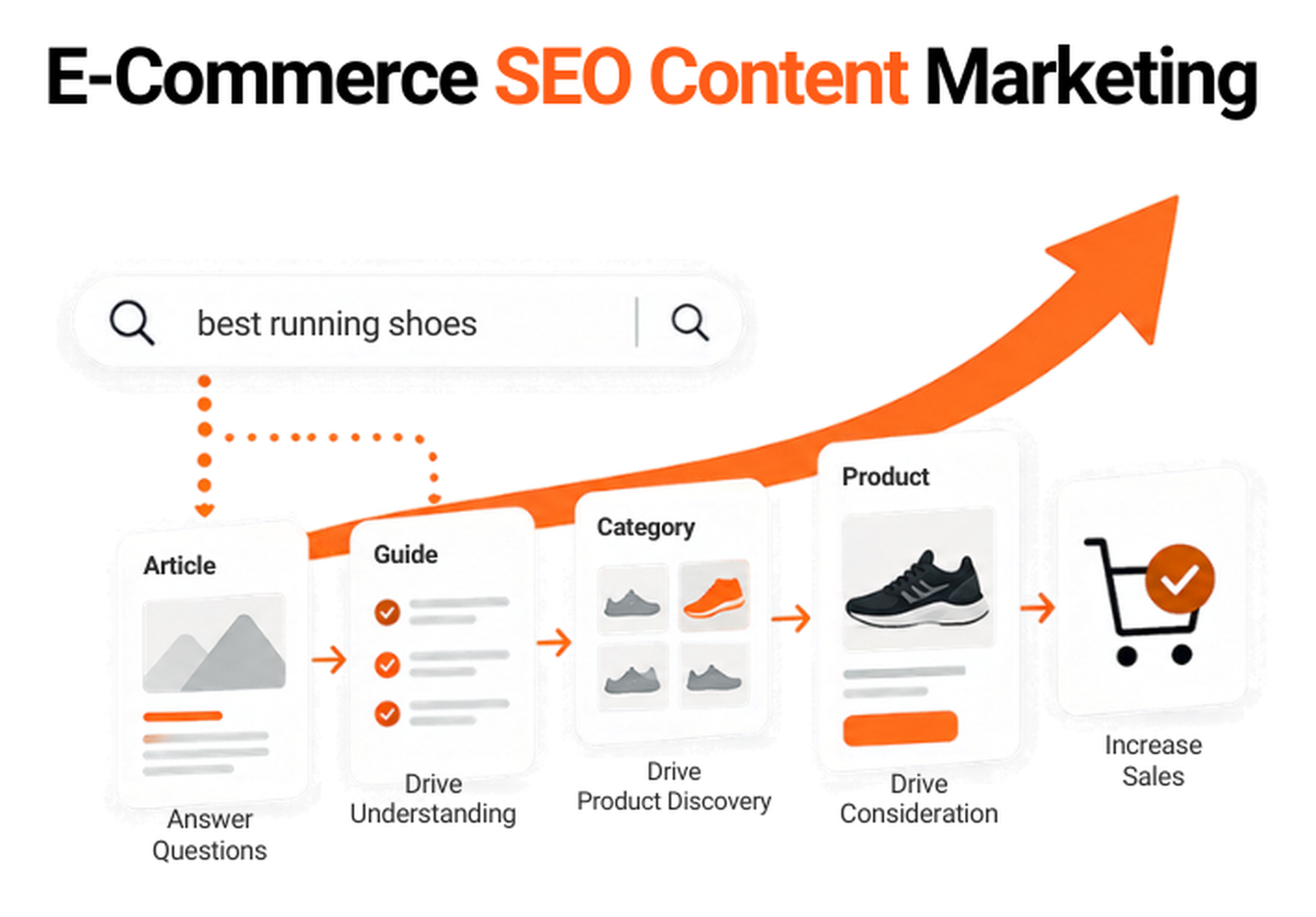
A shopper types a query into a search bar. They land on your page, scroll for ten seconds, and bounce.
Despite this being an adverse event, your SEO report can show this page as a success. After all, it ranked and attracted organic traffic. Perhaps it even gained thousands of visits.
But for an e-commerce business, traffic without commercial intent is an incomplete outcome.
True search strategy goes way beyond squeezing a product page or blog post onto page one. It requires mapping what people are searching for, why they are looking, what friction they need removed before buying, and how your site guides them from one stage of that decision to the next.
That is the role of e-commerce SEO content marketing.
It aligns search demand with actual product positioning, converts informational queries into discovery moments, uses targeted education to build real consideration, and hardcodes commercial intent into your category architecture. Built right, it creates a friction-free pathway from search query to product discovery to purchase.
Because the objective is to attract the right searchers and give them a compelling reason to continue.
Look at how intent changes across a single category:
- A buyer searching “how to choose a mattress” is exploring options, miles away from checkout.
- Someone searching “best mattress for side sleepers” is deep in active comparison mode.
- Someone searching “king-size memory foam mattress” has immediate, transactional intent.
These queries all live in the same product ecosystem, but they represent entirely different moments in the buying journey.
An effective e-commerce SEO strategy recognizes these differences. It treats the keywords as signals of customer needs, commercial intent, and purchasing readiness. And this, then, determines the content you publish, the pages you optmize, the products you promote, the internal links you create, and the metrics you use to determine whether SEO is delivering.
What Is E-Commerce SEO Content Marketing?
E-commerce SEO content marketing combines search engine optimization, content strategy, product positioning, and conversion-focused website architecture.
Traditional e-commerce SEO concentrates on product pages, category pages, technical optimization, structured data, and keyword targeting.
But these elements do not cover the entire search journey. Customers do not begin every purchase by searching for a specific product.
They may start with a problem: How do I get rid of dry skin?
They may search for a solution: Best ingredients for dry skin?
Then move toward evaluation: Hyaluronic acid vs niacinamide.
And eventually become product-focused: Best hyaluronic acid serum.
The brand that only optimizes for the final query is entering the conversation late.
But the brand that answers the questions customers have while they’re defining the problem, exploring solutions, and comparing vendors has more opportunities to become part of the consideration set.
SEO content marketing vs. traditional e-commerce SEO
Traditional e-commerce SEO hyper-focuses on the pages sitting right next to the transaction. E-commerce SEO content marketing, however, changes that by expanding the playing field by mapping a clean path from start to finish:
Search query → intent → content → product/category → consideration → purchase
This creates a more cohesive search ecosystem.
A blog post should not exist merely because it has keyword potential. A comparison page should not exist just because competitors have one. A buying guide should not be created simply to increase indexed URLs.
Every piece of content should have a strategic function. Some pages capture demand, while others create it. Some answer objections, whereas others establish expertise. Some introduce products. And some help customers make the final decision.
The highest-performing e-commerce strategies make these functions work together as a single engine. Keyword research is foundational to e-commerce SEO, but search volume alone is a notoriously blunt instrument.
Start With Search Demand
Thousands of people can search for a topic every month without having any meaningful reason to buy the products a brand sells. At the same time, a smaller group of searchers may be looking for a very specific product, comparing their options, or trying to solve a problem that the product directly addresses.
That is why keyword selection should not begin and end with search volume. The more strategic question is what the search tells us about the person behind it.
A lower-volume search with strong product relevance and clear buying intent can therefore be far more commercially significant than a high-volume keyword positioned several steps away from anything the business sells.
Understanding different types of e-commerce search intent
Search intent can broadly be divided into several categories.
| Search Intent | What the Searcher Wants | Example Searches | Best Page Type |
|---|---|---|---|
| Informational | The searcher wants to learn, understand a problem, or explore a topic. These searches often occur earlier in the buying journey. | • How to care for curly hair • What is organic cotton? • How does retinol work? • How to choose running shoes | Blog posts, educational guides, how-to content, resource pages |
| Commercial Investigation | The searcher is researching potential solutions and beginning to evaluate products or categories. | • Best running shoes for beginners • Best moisturizer for sensitive skin • Organic cotton vs conventional cotton• Best laptops for graphic design | Buying guides, “best” articles, category pages, solution guides |
| Comparison | The searcher has identified potential options and is narrowing the field before making a decision. | • Brand A vs Brand B • Leather vs vegan leather • Air fryer vs convection oven • Protein powder comparison | Comparison pages, product comparisons, alternatives pages |
| Transactional | The searcher has a clear purchasing intent and is looking for a product, category, price, or place to buy. | • Buy men’s running shoes • Black leather handbag • Wireless headphones sale • Organic cotton bedsheets | Product pages, category pages, collection pages, product listings |
Identifying high-value searches
High-value search demand combines relevance, intent, commercial proximity, and achievable visibility.
Consider two hypothetical keywords: “What is sunscreen?” and “Best sunscreen for oily skin.”
The first is informational, while the second reflects a specific product need. Neither is inherently more valuable in every context – but they play different roles in the buying journey.
The strategy is to understand where each query belongs within the commercial architecture.
Move beyond search volume and keyword difficulty
Keyword difficulty can also become misleading when treated as the primary decision-making metric.
A more commercially-grounded assessment considers:
- Search intent
- Product relevance
- Business relevance
- Conversion potential
- Existing SERP competitors
- Content quality required
- Current website authority
- Existing topical coverage
- Customer questions
- Product margins or strategic priorities
This creates a more sophisticated concept of keyword value. A keyword is valuable when ranking for it can create a meaningful business outcome.
Once search demand has been identified, it should be organized into a structure. Think of this as a search-demand map. Instead of maintaining a disconnected keyword spreadsheet, group searches around:
Customer problem → solution → product category → product → purchase
For example, a skincare brand could identify a cluster such as:
Problem: Dry skin
↓
Solution: Hydration
↓
Ingredient: Hyaluronic acid
↓
Category: Hyaluronic acid serums
↓
Product: Specific serum
↓
Transaction: Buy hyaluronic acid serum
This hierarchy reveals opportunities that are obscured by isolated keyword research. It also provides a logical foundation for internal linking.
- The informational article introduces the problem.
- The educational article explains the solution.
- The category page presents relevant products.
- The product page facilitates the transaction.
SEO content now becomes an interconnected commercial system.
Build an E-commerce Content Ecosystem That Supports Buying Decisions
In a successful e-commerce website, different pages serve separate roles, and high-performing strategies connect them into a unified ecosystem.
The most effective architectures seamlessly blend:
- Core Commercial Pages: Homepages, category pages, subcategory pages, and product pages.
- Decision-Enabling Content: Buying guides, comparison pages, “best” roundups, and product alternatives.
- Contextual Support: Educational articles, FAQs, glossaries, and resource hubs.
Each page should have a clearly defined role.
Category Pages As Commercial SEO Assets
Category pages are among the most important SEO assets on an e-commerce website. They can target high-value commercial searches while allowing users to browse multiple products.
A category page targeting “women’s running shoes,” for example, can satisfy a user who knows the product type but has not yet selected a specific model.
The page can also explain:
- Scope: Clarify what products belong in the category.
- Audience: Define exactly who the products are built for.
- Differentiation: Highlight the core differences between choices.
- Criteria: Outline what matters most when selecting a model.
- Use Cases: Connect products to real-world scenarios.
- Features: Break down technical specs without clutter.
- Support: Answer common customer questions right on the page.
This creates a richer commercial destination than a simple grid of product cards.
Product Pages As Conversion Destinations
A high-performing product page functions as your best digital sales rep. Beyond displaying a name, image, price, and “Add to Cart” button, it actively answers the critical questions standing between a hesitant shopper and the checkout button.
Depending on the product, a high-converting page addresses:
- Identity & Fit: What is it, who is it built for, and what exact problem does it solve?
- Functionality: How does it work, how should it be used, and what are the specific technical details?
- Decision Support: What makes it different from alternatives, which size or variant should the customer choose, and what is included inside?
The more consequential the purchase, the more information may be required. Good product content reduces uncertainty – and reducing uncertainty is a crucial part of conversion.
For products sold online, Product structured data can also help Google understand information such as product details, price, availability, reviews, and offers.
Informational Content That Creates Product Demand
Informational content often receives less commercial attention because it is further from the transaction. Treating it as an afterthought is a missed opportunity.
When a customer starts their search, they may not know your brand or even which exact product category they need. Educational content provides a powerful way to enter that journey long before your competitors do.
Consider a targeted query like: “How to choose a mattress for back sleepers” which can introduce a mattress retailer to someone who has not yet decided which brand to buy.
This introduces a mattress retailer to a buyer who is still exploring options.
A strong educational piece breaks down firmness, materials, sleeping positions, and support criteria, and then seamlessly bridges those insights directly to relevant product categories.
That is how educational SEO begins contributing to commerce.
Create Content For Every Stage Of The E-Commerce Buying Journey
A sophisticated content strategy should mirror the way people actually make purchasing decisions.
The shopping journey is not very linear. Customers jump between research, comparison, reviews, marketplaces, social platforms, and search results.
Still, several recurring stages provide a practical framework for planning content, messaging, and distribution.
Problem-Aware Searches
The customer recognizes a problem. Examples include:
- Why is my hair so dry?
- How to reduce kitchen clutter
- Why do my running shoes hurt my feet?
- How to keep coffee fresh
The customer may not yet be thinking about a specific product. Content should prioritize clarity and education.
Solution-Aware Searches
Now the customer has started exploring possible solutions. Examples:
- Best ways to hydrate dry hair
- Storage solutions for small kitchens
- Running shoes for foot support
- How to store coffee beans
This is where product categories can begin appearing naturally.
Product And Category Searches
The customer understands what they need. Now they search for products. Examples:
- Hydrating hair mask
- Kitchen storage containers
- Supportive running shoes
- Airtight coffee container
Category pages become essential here.
Comparison And Evaluation Searches
The customer has options and now they need help choosing. Examples:
- Best hydrating hair masks
- Ceramic vs stainless steel cookware
- Brand A vs Brand B
- Product X alternatives
Comparison content can address the decision criteria directly, but it should not turn into disguised advertising. Credibility depends on acknowledging meaningful trade-offs.
Transactional Searches
Finally, the customer is ready to purchase. Examples:
- Buy hydrating hair mask
- Stainless steel cookware set
- Brand X running shoes
- Coffee storage container
These searches should lead to pages designed for commerce. The objective is simply to minimize friction between intent and transaction.
Turn Rankings Into Revenue With Strong Commercial Architecture
Ranking is only the beginning; the more consequential question is what happens after the click.
A user arrives at a blog post. What next?
If the article ends without a logical next step, the commercial value of that organic visit may be limited. This is something called the article island problem.
- The content ranks.
- Traffic arrives.
- The visitor reads.
- Then leaves.
Without any category discovery, product exploration, meaningful commercial interaction, or any purchase.
Search Intent Should Determine the Destination Page
Different searches require completely different landing experiences.
- A user searching for “How to clean white sneakers” is looking for instruction and is not ready to be dropped onto a product page.
- Someone searching for “White leather sneakers women” has shifted into active exploration and wants to browse products immediately.
Matching intent with the right destination page creates a seamless and coherent user experience from the very first click.
Design Content-to-Product Pathways
A content page should have relevant pathways toward the next stage.
Consider this continuous progression:
Article: How to choose a hiking backpack
↓
Guide: Backpack size and capacity
↓
Category: Hiking backpacks
↓
Product: 40L hiking backpack
↓
Purchase
The links should help the reader move forward and not seem like they’ve been inserted merely for SEO.
Use internal links to transfer relevance and intent
Internal links create relationships between pages. A strong internal-linking structure can help search engines understand topical relationships while also helping users discover commercially relevant resources.
Google specifically says links help it discover pages and understand relevance, and recommends descriptive anchor text. It also recommends linking important pages from relevant pages elsewhere on the site.
For example, an article about choosing running shoes could link to:
- Running shoe buying guide
- Road running shoes
- Trail running shoes
- Stability shoes
- Specific product collections
The anchor text should provide meaningful context. More importantly, the linked page should genuinely satisfy the next question.
Avoid The Article-Island Problem
Every major content asset should have a reason to exist within the wider site architecture.
Ask: What should someone do after reading this?
The answer doesn’t always have to be an aggressive “buy now.” Depending on where the user is in their decision-making process, the logical next step might be to:
- Read another guide
- Explore a category
- Compare products
- View a relevant collection
- Understand a product feature
- Subscribe for further information
The pathway should reflect the user’s level of intent.
E-commerce Content Optimization: What Actually Helps Pages Perform?
Good SEO content is not simply content containing the target keyword a prescribed number of times. Modern search requires substantially more contextual depth.
Create Genuinely Useful, Original Content
Thin content is easy to produce. Content that helps someone understand a problem, evaluate options, or make a decision requires thought. Google’s documentation specifically discusses original information, substantial coverage, first-hand expertise, clear sourcing, and adding value beyond simply rewriting existing sources.
A strong page should contribute something beyond what already exists across the search results, and that could come from:
- Original expertise
- First-hand product knowledge
- Detailed comparisons
- Better explanations
- Unique examples
- Product demonstrations
- Proprietary insights
- Expert commentary
- Original research
- Clear decision frameworks
The objective is to make the page more helpful.
Optimize Headings, Entities, Terminology, And Topical Depth
Search engines rely on relationships between concepts. A page about running shoes, for example, could also naturally discuss:
- Cushioning
- Heel drop
- Stability
- Pronation
- Terrain
- Fit
- Foot strike
- Midsole materials
- Durability
These interconnected concepts build true semantic richness. They prove to search engines and users alike that the content actually understands the subject matter and is not just lazily repeating a target keyword.
This depth of topical authority is precisely why sophisticated e-commerce SEO moves far beyond keyword stuffing.
Use Product-Led Content Without Making Every Page Promotional
There is a delicate balance to strike in e-commerce content. While your strategy must support commercial objectives, relentless self-promotion can cause your utility to take a hit.
- Educational content should genuinely educate.
- Comparison content should fairly weigh alternatives.
- Buying guides should help customers make informed decisions.
- Product pages should seamlessly facilitate the sale.
When every article aggressively pushes a product, the content begins to resemble advertising instead of expertise, which can then affect trust.
Use FAQs Strategically
FAQs are powerful tools when they address genuine lingering customer uncertainties.
Effective FAQs target friction points:
- How long does the product last?
- Is this suitable for beginners?
- What size should I choose?
- Can this be used outdoors?
- How does this compare with the previous model?
- What materials are used?
Strict relevance is the name of the game here – FAQs should never become a keyword-stuffing dumping ground. Their sole purpose is to resolve the exact questions that customers ask before making a purchase.
Optimize For Users And Search Engines Simultaneously
Search optimization should not be treated as an exercise separate from user experience. Building for users enables search engines to benefit by default.
- Clear structures help both.
- Useful headings help both.
- Descriptive language helps both.
- Logical internal links help both.
- Comprehensive answers help both.
The strongest performing pages are engineered around search behavior and human decision-making simultaneously.
Build Topical Authority Around Products, Categories, And Customer Problems
Topical authority is particularly important for e-commerce brands operating in competitive categories.
One article struggles to establish meaningful expertise. It could answer one specific question, but customers often have many related questions before they decide what to buy. That is why you need a connected body of useful content.
Imagine an outdoor equipment retailer trying to build visibility around hiking backpacks.
An article such as “How to Choose a Hiking Backpack” is useful, but it only covers one part of the topic.
A stronger content ecosystem will cover:
- Hiking backpack sizes explained
- Daypack vs. overnight backpack
- Best hiking backpacks for beginners
- How to pack a hiking backpack
- Backpack fitting guide
- Hiking backpack materials
- Waterproof vs. water-resistant backpacks
- Internal-frame vs. external-frame backpacks
- Hiking backpacks by capacity
- Product comparisons
- Product category pages
- Individual product pages
Each page answers a different question or serves a different purpose. Some help customers understand the category, while others help them compare their options. Product and category pages then connect that research to what the brand actually sells.
These pages join hands to create a semantic lattice around the category.
From Isolated Keywords To Topic Clusters
Keyword research can easily become a list of isolated opportunities: find a keyword, create a page, and move on to the next. A topic-cluster approach starts by asking what exactly it is that the customer needs to know before they can make a decision.
For an outdoor retailer targeting hiking backpacks, that could mean connecting the main category page with content around backpack sizes, how to choose a backpack, daypack vs. overnight packs, fitting guides, packing guides, and product comparisons such as 40L vs. 50L hiking backpacks.
Each page answers a different question, but together they cover the customer’s journey from understanding their needs to evaluating products and making a purchase.
That’s the value of topic clusters – more connected content with a clear purpose.
Cover The Questions Customers Ask Before Purchasing
Keyword tools have a limitation – they don’t always capture the real questions buyers ask before spending their money. Your sales team hears them every day. Customer service fields them. Product reviews, community forums, and returns expose them too. If customers repeatedly ask whether a product works in a particular environment, that question might benefit from a detailed explanation.
Mining these sources uncovers high-impact content opportunities. You can turn those questions into publishing assets using a fairly simple and repeatable process:
- Collect the questions: Pull the most frequent inquiries from sales and support teams. Dig through customer reviews, forums, and product returns to spot recurring friction points.
- Group similar questions: Look for underlying patterns. Multiple variations of a question usually point back to the exact same core buying concern.
- Identify content gaps: Audit your site to see if those questions are already answered. If the answer is missing, buried, or incomplete, you’ve found a content opportunity.
- Match the question to the right page: Decide where the answer belongs – whether that is a standalone article, a buying guide, a comparison, a category page, an FAQ, or a product page.
- Connect it to the buying journey: Bridge the content directly to relevant categories and products so customers can move naturally from finding an answer to evaluating their options.
Take a common e-commerce example: if customers repeatedly ask whether a specific hiking backpack holds up in heavy rain, that insight should become a dedicated guide comparing waterproof versus water-resistant packs, seamlessly supported by internal links to the right products.
This gives us a message: start with what customers actually need to know, then look for the search opportunity – never the other way around.
Make E-commerce SEO Content Useful To AI Search And LLMs
Search has changed significantly. Before AI-generated answers, users had to visit websites to research questions and compare options.
Today, AI Overviews and AI Mode can answer increasingly complex questions directly within Google Search while also providing links to supporting websites. This changes how users discover and interact with organic content.
That makes AI visibility immensely important.
However, optimizing for AI search doesn’t require an entirely separate SEO playbook. Google’s guidance for AI search experiences emphasizes the same SEO fundamentals that help content perform in traditional search, including creating helpful content, making pages accessible to Google, using internal links effectively, and providing clear information about products and businesses.
Your aim should be to make your website a clear, credible, information-rich source that AI systems can understand and potentially reference.
For e-commerce brands, the bigger opportunity is connecting AI visibility to purchase intent.
A customer might start with “What size hiking backpack do I need?”, move to “What is the best hiking backpack for a 2-day trip?”, and eventually ask “What is the best 40L hiking backpack?”
The query’s commercial intent strengthens as it moves closer to a product decision.
So AI visibility goes far beyond generating impressions or mentions. It comes into play when customers are researching, comparing, evaluating, and choosing products.
The Importance Of Structured Information
Clear and well-structured information is easier for both users and LLMs to understand. It includes using clear definitions, descriptive headings, specific product information, consistent terminology, logical page relationships, and detailed explanations.
Product pages can also use Product structured data to provide search engines with information such as price, availability, reviews, and product details.
An e-commerce website should make it easy to understand:
- What the company sells
- Which categories it serves
- Which products belong to those categories
- What problems the products solve
- Who the products are designed for
- How products differ
- What evidence supports relevant claims
The clearer these relationships are, the easier it is for customers and AI systems to understand the website, its products, and the context in which they are relevant.
Answer Questions Clearly
AI-driven search experiences depend on extracting useful information from multiple sources. Pages that bury the answer beneath generic introductions create unnecessary ambiguity.
Make sure to answer the question directly, then provide context. For example: What is the difference between trail running shoes and road running shoes?
Start by specifying the difference. Then move on to construction, traction, cushioning, terrain, durability, and selection criteria.
This creates content that is both human-readable and machine-interpretable.
Strengthen Entity And Brand Associations
Brands become easier to understand when their expertise is consistently demonstrated around specific subjects.
For example, an e-commerce brand selling specialty coffee equipment can develop a strong content association with:
- Coffee grinders
- Brewing methods
- Grind size
- Extraction
- Espresso
- Pour-over
- Coffee storage
- Brewing equipment
Gradually, the website becomes a recognizable information source on that subject. That is more durable than producing disconnected articles around whatever keyword happens to have attractive volume.
For brands developing this capability, Revnium provides a useful reference point for connecting SEO content with search intent, qualified traffic, and commercial outcomes.
The broader principle is important: Visibility becomes more valuable when the brand is associated with the subject behind the search.
Become A Reliable Source Within A Niche
You should use e-commerce SEO to establish your brand as a recognized and trusted authority within your entire product category. That said, achieving that level of authority requires deliberate consistency.
A brand selling home fitness equipment, for example, has an opportunity to develop substantive coverage around exercise equipment, training considerations, product selection, maintenance, comparisons, use cases, and buyer questions. Those connections form an information footprint.
As these pieces of content connect with one another, they create a broader information footprint around the brand. Customers can find answers across different stages of their research, while search engines and AI systems gain more context about the brand, its expertise, products, and areas of relevance.
This depth of coverage can then help establish the brand as a trusted source of information within its category.
Measure What Is Relevant: From Rankings To Revenue
SEO reporting starts with rankings and organic traffic, both of which only show part of the picture.
For an e-commerce business, we want to know what happens after someone finds the website. Are they visiting product and category pages? Are they adding products to their cart? Are organic visitors converting into customers? Which content and search queries are contributing to revenue?
Moving beyond vanity metrics means tracking indicators that tie search visibility directly to financial impact:
- Assisted and Direct Organic Revenue: Measuring the total sales influenced or closed by organic search channels.
- Category-Level Visibility and Growth: Tracking how core product categories expand their footprint and capture high-intent demand over time.
- Content-to-Conversion Pathways: Analyzing how educational and informational assets successfully transition readers into product consideration and checkout.
- Efficiency and Return on Investment: Evaluating the long-term compounding value of organic content compared to paid acquisition channels.
Shifting the reporting focus from raw traffic to commercial impact ensures your SEO strategy remains aligned with business growth.
Why Organic Sessions Are An Incomplete KPI
Suppose one article generates 30,000 organic sessions and another generates 3,000. The first article naturally appears to be the greater success – at least at a cursory glance.
But what if:
- Article A generates 30,000 visits and $1,000 in revenue.
- Article B generates 3,000 visits and $8,000 in revenue.
Traffic tells only part of the story – the second article may be attracting a much more commercially relevant audience. This is why traffic should be interpreted alongside downstream behavior.
Measure Content-to-Product Performance
Organic traffic becomes more meaningful when you can see what visitors do after they land on your content. Tracking the right metrics helps connect SEO performance to commercial outcomes, such as:
- Revenue Metrics: Organic revenue, assisted revenue, and revenue per organic session.
- Engagement Metrics: Product-page visits from organic content, category engagement, and internal-link click-through rate.
- Conversion Metrics: Add-to-cart rate, conversion rate, and assisted conversions.
- Retention Metrics: Returning organic visitors and repeat engagement with product or category content.
The metrics you prioritize will vary by business model, customer journey, and analytics setup. What is crucial is connecting organic traffic with the actions and outcomes that follow.
The real value of SEO lies in what visitors do after they click.
Evaluate Organic Revenue (Not Just Organic Visibility)
Organic visibility is an essential piece of the puzzle, but it is only the first stage in the journey toward actual revenue. A comprehensive reporting framework traces the entire path from search to sale:
Visibility → qualified traffic → engagement → product discovery → add to cart → purchase → revenue
Looking at this full funnel helps you pinpoint precisely where organic search drives business results and where potential customers drop off along the way.
Most importantly, it shifts your reporting from simply tracking how often a brand appears in a search engine to understanding how that visibility translates directly into sales.
Common E-Commerce SEO Content Marketing Mistakes
Even sophisticated e-commerce brands can fall into the same content and SEO traps. These mistakes are often the result of focusing on individual tactics without looking at how the entire content ecosystem supports search visibility, customers, and revenue.
Chasing High-Volume Keywords Without Commercial Relevance
High search volume can look attractive in a keyword report, but volume alone says little about whether those searches come from potential customers.
Even a page attracting thousands of visitors can contribute very little to the business if the audience has no connection to the products being sold.
The focus should be on relevant search demand that can contribute to the customer journey and commercial outcomes.
Publishing Content Without A Conversion Pathway
A blog can rank beautifully while making a negligible contribution to sales.
The content is disconnected from the system if it restricts readers from easily discovering relevant categories or products. Every significant content asset should have a logical next step.
Cannibalizing Category and Product Pages
Throwing up multiple pieces targeting nearly identical phrases creates internal friction. If you have overlapping pages for general recommendations, beginner guides, and product comparisons without distinct intent, they end up fighting each other for rankings.
Clean architecture gives every page a single and distinct job.
Creating Thin Or Repetitive AI-Generated Content
Generative tools make publishing faster, but they make boring content faster too. Pumping out hundreds of carbon-copy pages with zero original insight just bloats your site architecture without building real topical authority.
Use AI to streamline your research and drafting while keeping the substance uniquely human.
Treating SEO as a publishing exercise
Volume is never a strategy on its own. The real metric of success is whether your content improves how your site captures demand and helps buyers make decisions.
A smaller ecosystem of strategically connected pages can be more valuable than a massive archive of disconnected articles.
A Practical E-commerce SEO Content Marketing Framework
A scalable strategy can be organized into five stages.
Stage 1: Research the Market and Search Demand
Start by understanding what customers are searching for and what influences their purchasing decisions.
Look for:
- Customer problems
- Product categories
- Search themes
- Commercial queries
- Informational questions
- Comparison searches
- Competitor content
- SERP features
- Customer objections
- Product differentiators
Search volume can help identify demand, but it shouldn’t be the only consideration.
Look for the commercial meaning behind the search – who is searching, what are they trying to accomplish, and where does that search fit into the buying journey?
Stage 2: Map Intent To Pages
Determine which page should satisfy each major search intent.
| Search Intent | Appropriate Page |
|---|---|
| Educational | Blog / Guide |
| Problem-solving | Educational Content |
| Product category | Category Page |
| Product-specific | Product Page |
| Comparison | Comparison Page |
| Best-of research | Buying Guide |
| Transactional | Category / Product Page |
This prevents content from being created without a destination strategy.
Stage 3: Build The Content Ecosystem
Create connected content around your most important product categories.
From understanding the problem to comparing options and evaluating specific products, a strong cluster covers all the questions customers have before purchasing.
The ultimate objective is comprehensive coverage, with each page contributing something useful to the wider topic.
Stage 4: Connect Content to Products
Build internal links between:
Informational content → commercial content → products
For example, an article about choosing a hiking backpack could link to a backpack sizing guide, the hiking backpack category, and relevant 40L or 50L products. The links should make sense in context and help the customer take the next logical step.
Stage 5: Optimize, Measure, and Expand
Hitting publish is just the starting line. Regularly auditing your performance turns raw data into a compass for expanding your entire ecosystem.
Keep a close eye on the full spectrum of performance metrics:
- Rankings and search queries
- Organic traffic and engagement
- Internal-link behavior and product discovery
- Conversions and revenue
- Content gaps and competitor shifts
Feed those insights straight back into refining your site. High-performing assets can be expanded into deeper guides, weak or overlapping pages can be consolidated, and newly discovered customer questions turn into fresh content opportunities while commercial pages get fortified based on real search behavior.
Conclusion: Turn Search Demand Into Sales
E-commerce SEO content marketing is not about publishing more articles or chasing every keyword with attractive search volume.
It is about understanding why people search, what they need at each stage of the buying journey, and how the website can help them move from discovery to decision.
The most valuable SEO strategy connects the entire journey:
Search demand → useful content → product discovery → consideration → purchase
Every component plays a distinct role in that ecosystem:
Topical authority establishes your brand as a recognized leader around the problems, products, and categories that matter most to your market.
- Informational content builds initial awareness.
- Buying guides eliminate customer uncertainty.
- Comparison pages support evaluation.
- Category pages capture commercial intent.
- Product pages convert that demand into revenue.
- Internal links tie the entire architecture together.
- Attribution metrics reveal what actually drives sales.
For any e-commerce business, the central metric of success shouldn’t be about how much raw traffic you generated. The real question is much simpler: “Did our search visibility help the right customers discover, understand, consider, and purchase our products?”
That is the definitive line separating content that merely attracts window shoppers from content that drives actual business growth.
Search demand already exists out there. The real opportunity lies in building the architecture that captures that demand and channels it straight into qualified product discovery, commercial consideration, and sales.
Want your e-commerce SEO to generate more than traffic? Build a content strategy around search intent, product positioning, and revenue.