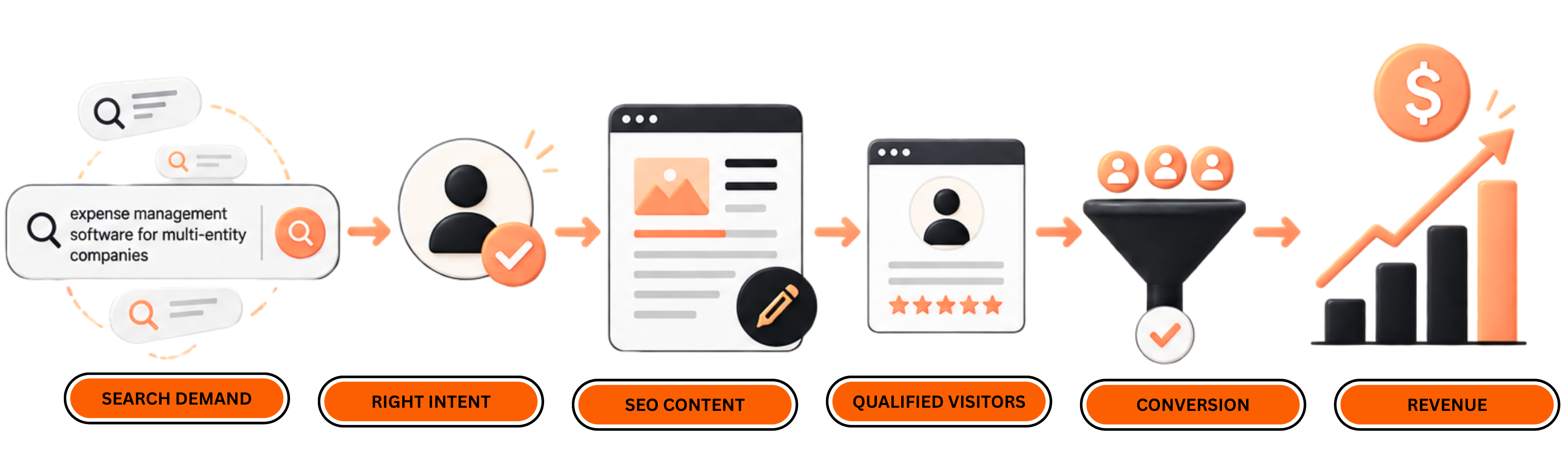
You could double your organic traffic without making meaningfully more money from search.
And there’s nothing really strange about it. Search volume tells you how often people look for something, and rankings tell you whether you are managing to get in front of them.
The problem is that neither of them tell you anything about whether those people have reason to become customers.
Yet, more often than not, the first step in any SEO planning begins with a keyword spreadsheet. You find something relevant to the business, notice that a few competitors are ranking for it, check that the volume is decent and the difficulty is manageable, and decide it is worth an article.
The real person making the search never finds its way into the discussion.
Someone has typed those specific words because they are trying to understand something, solve a problem, compare their options, or make a decision. And what they are trying to do is of far greater commercial significance than the number sitting in the search-volume column.
A keyword tells you that demand exists – but you also need to know whether that demand is worth capturing.
Making SEO content contribute to revenue starts with working out which demand is.
Search Demand Is Not The Same As Revenue Potential
Search volume is useful, but it is very easy to treat it like it can tell you more than it is actually capable of. It can tell you that a lot of people search for something.
What it cannot speak to is whether those people are likely to become customers, whether the problem matters enough for them to spend money solving it, or whether your business is particularly well placed to help.
This is a crucial distinction, because most search demand is small anyway. Ahrefs found that around 94.74% of keywords get ten searches per month or fewer.
Meaning, if you only pay attention to the bigger numbers, you’ll end up filtering out an enormous amount of demand before asking whether any of it might actually be valuable.
Take an expense-management platform. “What is expense management?” will attract a much larger audience than “expense management software for multi-entity companies.”
But, pay attention. That first query could have come from a student, a junior employee, someone writing an article, or a business owner who has only just started thinking about the problem. There may still be commercial value in reaching some of those people, but the query itself tells you almost nothing about that.
The second search is narrower. Whoever typed it has already revealed something about the problem they are dealing with and the kind of solution they are considering.
Now, this does not automatically mean that it is a ‘better’ keyword. Perhaps the market is tiny, the product is a poor fit for multi-entity businesses, or the broader topic consistently introduces future customers to the category.
The point is, it is not possible to settle any of those questions simply by studying the search volume.
A small keyword can represent a valuable buying situation. A large one can bring thousands of people who were never especially likely to buy from you.
Both can also be worth targeting, but for entirely different reasons.
So the question you need to ask is:
Which searches represent demand our business should actually want to capture?
Find The Search Demand Worth Capturing
Once you stop treating search volume as a proxy for value, you need another way to decide what deserves your attention.
Intent fit is a useful starting point. Look at the problem or goal behind the search and ask whether it belongs naturally in the world your business operates in.
Could one of your better customers plausibly make this search? Is it connected to a problem you genuinely help solve?
This does sound intuitive, but relevance tends to get put on the back burner pretty quickly if a keyword has enough traffic attached to it.
Next, consider business value. Some topics may live very close to what you sell, while others require several paragraphs of creative reasoning before the product can even be mentioned.
If you have to force a connection between the reader’s problem and your solution, the traffic may be relevant in a broad sense without having a lot of commercial usefulness.
You still need to understand the size of the opportunity, of course. This is where traffic potential is more useful than staring at the volume for one keyword. A page could rank for for dozens or hundreds of related searches, including long-tail variations and adjacent questions that barely register individually.
The better question is how much relevant demand exists around the topic as a whole.
The next factor is conversion confidence, and this is where SEO research should start borrowing from the rest of the business.
Maybe similar organic pages already generate qualified leads. Perhaps paid search tells you that people using certain language tend to convert. Sales calls, customer interviews, CRM data, and existing conversion paths can all give you clues about which kinds of search demand are more likely to turn into something valuable.
Finally, there is strategic relevance, which is about whether a topic reinforces the exact problem, use case, capability, or category you want buyers to associate with your company.
That makes them more useful than their immediate traffic numbers might suggest.
At Revnium, we can reduce those considerations to five questions:
| Factor | Question |
|---|---|
| Intent fit | Is this search being made by someone with a problem we solve? |
| Business value | Can the topic naturally connect to what we sell? |
| Traffic potential | Is there meaningful demand across the wider topic? |
| Conversion confidence | Do we have evidence that this kind of demand converts? |
| Strategic relevance | Do we want to be known for this subject? |
You can score each one from 1 to 5 if that helps you compare opportunities, although the arithmetic should never be mistaken for certainty. It is there to make the reasoning visible.
Ranking difficulty and production effort come afterwards. They tell you how hard an opportunity may be to pursue, not how valuable it is. An easy keyword can be a waste of time, while a difficult one may be worth the investment because the people behind it are exactly the people you want.
That is why a moderate-volume topic with strong commercial alignment can sometimes deserve far more attention than a much larger keyword whose visitors have little reason to become customers.
Understand What The Searcher Actually Needs
SEO tools are good at putting searches into buckets. Informational, commercial, and transactional intent, while useful labels, can only get you so far.
Knowing that someone is conducting an ‘informational’ search still leaves a much more important question unanswered:
What are they actually trying to figure out?
Consider someone searching for ‘CRM implementation timeline’. The obvious answer is a number: perhaps implementation takes six weeks, three months, or somewhere in between.
But there is a good chance the person cares about much more than the calendar.
They may be wondering how much work their team will have to do, how disruptive the switch will be, when people will start seeing value, or whether recommending a new CRM is going to create a headache they will later have to explain to everyone else.
An article that gives them a generic timeline without addressing any of them is technically answering the query, but doing almost nothing to help with the decision behind it.
What the searcher already knows also needs to be factored in. Someone asking ‘why is inventory forecasting inaccurate?‘ is in a very different position from someone searching for the ‘best inventory forecasting software‘. The first person may still be trying to diagnose the problem, while the second one has already moved far enough to start comparing ways of solving it.
Sending both of them to roughly the same article because the keywords belong to the same topic shows no appreciation for this difference.
This is why it helps to think in terms of uncertainty. What does this person still need to understand before they can make progress? It could be the cause of a problem, the available approaches, the cost, the implementation effort, the risks, the alternatives, the expected results, or whether a particular solution will fit their situation.
As someone gets closer to spending money, those unanswered questions increasingly determine whether they move forward or not.
You also need to resist the assumption that the answer should always be another blog post. Sometimes the best response to a search is a calculator, a template, a comparison page, a category page, a product page, a directory, or an interactive tool. Ahrefs has documented an example where changing a page to better match the experience searchers were looking for increased its traffic by 516%.
E-commerce makes this distinction between intent and format especially obvious. Someone searching for ‘best running shoes for flat feet’ may want a buying guide or a carefully curated category page. ‘Nike Pegasus vs ASICS Gel Nimbus’ calls for a proper comparison. ‘What size running shoe should I buy?’ might be far better served by a sizing tool or fit guide than by 1,500 words of prose.
Content format is part of search intent because the searcher is asking about a subject in order to complete a specific task or make a decision.
Before deciding what to write, work out what would genuinely help them do it.
Create Content That Helps The Buyer Make Progress
Once you understand what someone needs from a search, creating the content goes from being about trying to cover a topic comprehensively to helping them leave with greater clarity than they arrived with.
Help Them Understand the Problem
Sometimes the reader knows something is wrong without understanding exactly what is happening.
Customer churn has increased. Forecasting has become unreliable. A process suddenly takes twice as long as it should. They can see the symptom, but they may still be figuring out the cause or how serious it is.
Content about causes, symptoms, benchmarks, common mistakes, troubleshooting, or ways to assess the problem can therefore be commercially useful long before someone starts comparing products. It gives them a clearer picture of what they are dealing with and whether they may eventually need a solution.
Help Them Understand Their Options
Someone further along understands the problem clearly, even if the solution is still being worked out.
They want to know which approaches exist, how they work, what each one requires, and where the trade-offs are. This is where frameworks, process guides, implementation models, workflows, and detailed explanations of different methods become useful.
The product does not need to dominate the discussion. If your company has genuine expertise in solving the problem, helping the buyer understand the solution landscape already gives the content a commercial role.
Help Them Choose the Right Option
The questions eventually turn much more concrete.
Which option fits us? What will it cost? How difficult will it be to implement? How does this compare with the alternative? What happened when another company like ours used it?
Vague educational content does not help a great deal at this point. Buyers need comparisons, pricing information, use cases, implementation details, customer stories, product examples, and evidence that lets them judge suitability for themselves. If you’re making a claim, back it up with a concrete example. Also explain any limitations or trade-offs.
Early-Stage Content Still Has a Job
None of this means that every content strategy should pile into bottom-of-funnel keywords and abandon everything else.
Early-stage content can earn links, strengthen topical authority, introduce people to your category, create familiarity with your brand, support internal linking, and help future customers understand problems they may later pay to solve. A useful article does not need to produce a demo request before it has earned its keep.
The more crucial distinction is between content that has a commercial role and content that exists because somebody found a keyword.
If a topic gets 2,000 searches a month, that gives you a reason to investigate it. It does not, by itself, give you a reason to publish it. You need to be able to explain why this subject belongs in your strategy, what it helps the right reader understand, and how that understanding could eventually matter to the business.
The content does not always need to push the buyer toward a sale. It should help them make enough progress that the next decision becomes easier.
Deciding What Should Happen After the Click
A surprising amount of SEO content gets written first and only later given a conversion path.
The article is finished, the team is happy with it, and then someone asks what CTA should go at the bottom. Usually, the answer is whatever the company already uses everywhere else – book a demo, start a trial, contact sales.
But you need to decide the CTA before you write.
If the right person finds the page and gets what they came for, what would be a reasonable thing for them to do next?
Someone who has just learned why their forecasting keeps going wrong may want a benchmark, checklist, or deeper guide that helps them assess their own situation.
A person researching ways to solve the problem might be ready for a use-case page, calculator, implementation resource, or product-led guide.
A buyer actively comparing vendors could reasonably move on to pricing, a customer story, a detailed comparison, a trial, or a conversation with sales.
The next step changes, because the amount of commitment you can reasonably ask for changes as well.
Give The Reader Somewhere Sensible To Go
This is why putting a demo CTA on every article can seem so disconnected from the reason someone arrived there.
Imagine that you search for an explanation of why your inventory forecasts keep missing demand. You read a useful article, get a better understanding of the problem, and then the company immediately asks you to schedule 30 minutes with its sales team.
While you may like the company, you are just not at that stage yet.
A diagnostic checklist, an article about possible approaches, or a relevant benchmark might keep you moving. If those resources are useful too, then looking at the product later turns into a much smaller leap.
Good internal linking can help guide readers through that progression. A reader could move from an article explaining the problem to a guide covering possible solutions, then to an implementation resource, a comparison, and eventually a product or service page. Another reader might skip half of that because they arrived with more knowledge.
Real buying journeys are messy, so there is little value in pretending everyone will follow the same sequence. The point is simply to make the next relevant question easy to answer when it comes up.
Earn the Next Step
This also changes the way you think about conversion. Success does not always mean getting the visitor to buy, book, or sign up on the page where they first found you.
There are times when the commercially useful outcome is an improvement in their understanding of the problem and that they choose to keep learning from you. Sometimes it is that they move from general research to considering your approach.
And, sometimes, they really are ready to explore pricing or speak to someone.
A ranking earns the visit, but the content must justify the next step. Deciding what that next step should be before you write makes it much easier to create a page that leads somewhere naturally.
Measure SEO Content By Commercial Outcomes
SEO reporting has this habit of becoming most detailed when the stakes are the lowest.
That your ranking moved from eight to four, impressions increased by 335%, or organic sessions reached a new high is all worth knowing. But it tells you mainly whether you are becoming more visible and attracting more visitors.
The commercially interesting part comes afterwards.
And there is a noticeable chasm between the two. Omniscient Digital found that 62.9% of marketers considered revenue, conversions, or pipeline important measures of content success, yet only 31.8% connected organic growth to value metrics when reporting to stakeholders.
Follow the Measurement Further
Think of SEO measurement as a chain instead of a single dashboard.
- Impressions, rankings, and clicks tell you whether you are capturing search demand.
- Sessions, engaged visitors, and meaningful page actions tell you something about what happens after people arrive.
- Sign-ups, purchases, trials, qualified leads, and demo requests bring you closer to commercial value.
- Opportunities, pipeline, customers, and revenue show what that activity eventually meant to the business.
You do need the metrics at the beginning of the chain. A page cannot generate customers if nobody can find it.
The mistake is stopping there and simply assuming that more traffic must mean better SEO.
Suppose organic traffic grows by 80% while revenue attributable to organic search increases by only 5%. We’re not saying that this isn’t progress, but it should make you curious about the kind of demand you are now attracting.
One useful directional metric is revenue per organic visitor, calculated as:
Organic-attributed revenue ÷ organic visitors
Watch that alongside traffic growth, and you get a better sense of whether additional visitors are becoming more or less commercially productive.
The reverse is just as important. Organic traffic could remain fairly flat while better lead quality and higher revenue make the programme considerably more valuable.
Give SEO Credit for the Role It Actually Plays
Attribution makes this harder, particularly in B2B.
Someone might discover you through Google, read an article, leave, encounter the company again on LinkedIn, return a week later to read a comparison, and eventually come back directly before speaking to sales.
If they buy, a last-click report will credit the direct visit.
That is why it helps to distinguish organic-sourced revenue, where search initiated the attributable journey, from organic-influenced revenue, where search content played a meaningful part somewhere along the way.
You will never measure every interaction perfectly. You can, however, avoid treating the final click as the entire buying journey.
The payoff for doing this properly can be substantial. Omniscient Digital reports that Smartling generated around $3.7 million in organic-search pipeline through its product-led SEO programme. The number itself is less important than what underpins it – commercially relevant search demand, content connected naturally to the product, sensible conversion paths, and measurement that continued beyond the click.
That is ultimately what SEO reporting should tell you: whether capturing the demand created meaningful value for the business.
What AI Search Changes About This Strategy
AI search makes the case for chasing traffic for its own sake even harder to defend.
Google’s AI Overviews and other AI-powered search experiences can now answer some questions without requiring the searcher to visit a website at all.
And this is no longer confined to simple informational queries. Research from Semrush suggests that AI-generated results are increasingly appearing around commercial and transactional searches as well.
That does not make organic traffic unimportant. It does mean that assuming every impression should eventually become a click, is becoming less realistic.
The sensible response for businesses is to become more particular about the clicks they are trying to earn.
The Strategic Work Hasn’t Changed Much
You still need to understand what people are searching for and why.
You still need to decide which of that demand is commercially relevant to your business, create something genuinely useful for the person behind the query, bring expertise and evidence that make the content worth trusting, and give interested visitors somewhere sensible to go afterwards.
Google’s own guidance continues to emphasise helpful, reliable, people-first content, which points in much the same direction. Publishing another interchangeable article because a keyword has volume was never a particularly strong strategy, and AI search just gives businesses another reason to question it.
There will be plenty of tactical discussion about GEO, AEO, citations in AI answers, and whatever terminology comes next. Those questions are useful, but they reside downstream of the commercial decisions that actually determine whether search traffic is worth pursuing.
If fewer searches reliably result in website visits, the aim cannot simply be to squeeze as many clicks as possible out of search.
When earning each click becomes harder, the commercial quality of each click matters more.
Final Word: The Search Demand You Actually Want
Search is commercially interesting because people tell you, in their own words, what they are trying to understand, compare, fix, or decide.
But the existence of demand is just the beginning.
Some searches come from people you are well placed to help. Some reflect problems closely connected to what you sell. Some give you a natural opportunity to build trust, clarify a decision, or move someone closer to choosing a solution.
Others may bring plenty of traffic without doing much for the business at all.
That is why the most practical SEO questions are usually quite simple.
Is this our buyer? Is this a problem we genuinely help solve? What does this person need from us right now? What should happen if we help them? And, over time, did capturing that demand create meaningful business value?
A keyword tells you that demand exists, but not whether that demand is worth capturing.A keyword tells you that demand exists, but not whether that demand is worth capturing.